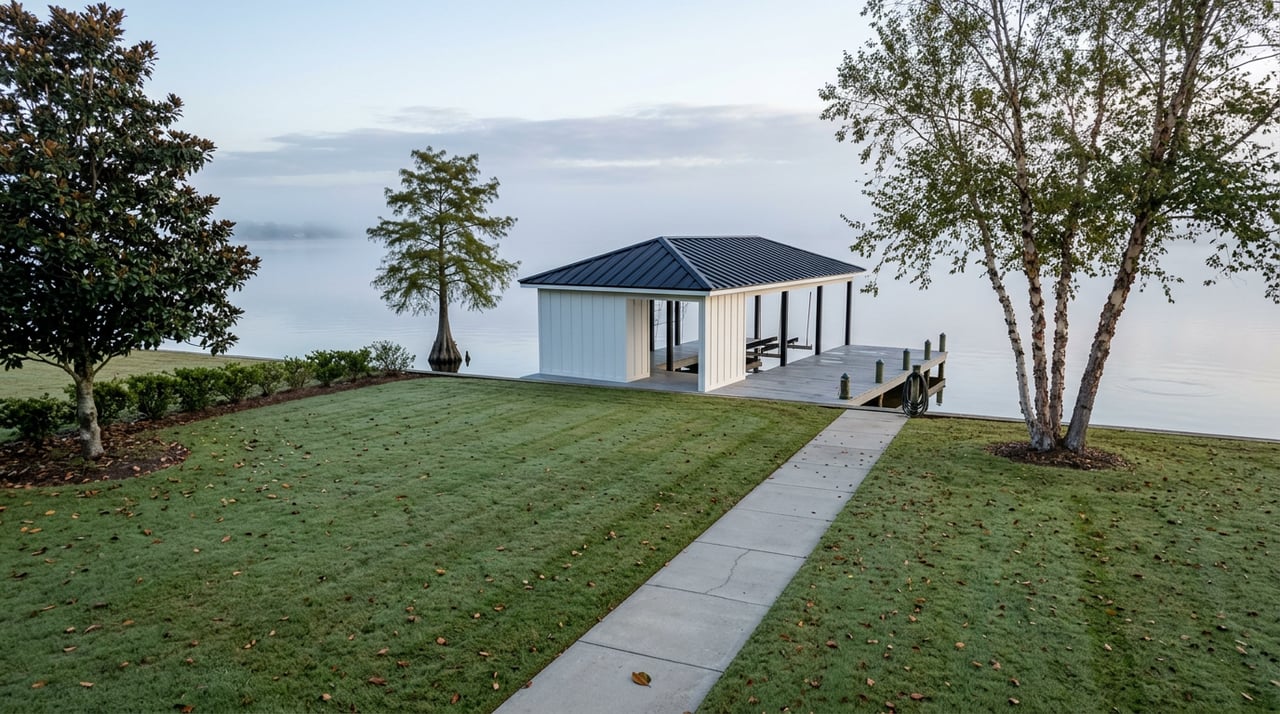
Buy a lakefront lot in Spring Creek Pointe and the listing will tell you a boathouse comes with it. What it will not tell you is that the boathouse does not transfer to your name the moment you close. Under the Tennessee Valley Authority's own shoreline rules, a private dock or boathouse permit is not deeded property. It is a permission slip tied to a specific owner, and TVA requires the new owner to notify the agency and file for a transfer within 60 days of taking title. Skip that step, or change so much as the roofline on an existing structure without asking first, and you are no longer working from your predecessor's approval. You are starting over.
That single rule explains more about how Spring Creek Pointe is priced and platted than any brochure will. The gap between a lakefront lot and a lake-access lot in this neighborhood is not really a view premium. It is the market price of a federal permit slot, and only a limited number of those slots exist along any given stretch of shoreline.
What the Two Lot Types Actually Buy
When Ainsworth Homes introduced Spring Creek Pointe with a community showcase in September 2025, the pricing split was already built into the plat. Lakefront lots opened at $959,000. Lake-access lots, sitting across the street with no direct shoreline, opened at $629,000. Rebecca Hinds, the company's vice president of design and sales, described the appeal at the time as a combination of city-limits convenience and lake access that buyers could not find packaged the same way anywhere else in Guntersville.
Will Ainsworth, the company's owner, put the daily experience in plainer terms during that same event: the goal was a neighborhood where people could reach the water every day, whether that meant walking down to a private boathouse or launching a boat from the shared neighborhood ramp. That distinction, private boathouse versus shared ramp, is the entire story. It is also not a design choice Ainsworth invented. It is a category TVA itself defines.
TVA's shoreline regulations split residential lots into what the agency calls backlots, meaning a lot with no direct shore frontage, and lots served by a community outlot, a single shoreline parcel that the subdivision's deed or covenants designate for shared use by every owner. Spring Creek Pointe's lake-access lots fall into that second category. Their owners get a real, deeded right to use the community launch. They do not get the standing to apply for an individual dock permit of their own, because the lot itself has no frontage to apply from.
The Fifty-Foot Ceiling
Here is the part that surprises most buyers walking the lots for the first time: even a waterfront lot in this subdivision is not guaranteed an individual boathouse simply because it touches the lake.
TVA's Section 26a regulations require that docks proposed in any subdivision recorded after November 1, 1999 sit at least 50 feet from a neighboring dock. When a stretch of shoreline cannot accommodate that spacing for every lot that fronts it, the regulation gives TVA the authority to require a group or community facility instead of individual ones. Spring Creek Pointe was recorded well after that 1999 cutoff, so every dock in the neighborhood is subject to the spacing rule, not grandfathered around it.
That means the number of individual boathouse permits available in a phase of Spring Creek Pointe is not a design decision Ainsworth can revisit later. It is math TVA does before a single permit gets issued: total linear feet of approvable shoreline, divided by the 50-foot minimum spacing, equals the ceiling on how many lots can ever hold a private dock. Everything past that ceiling gets routed to a community facility, no matter how much a buyer might want to add a private dock down the road.
The agency layers a second cap on top of the spacing rule. A dock, pier, or boathouse in a new subdivision cannot exceed 1,000 square feet of footprint unless it sits in an area of preexisting development, where the limit rises to 1,800 square feet. Spring Creek Pointe's new construction falls under the tighter 1,000-square-foot ceiling, which is worth knowing before anyone plans a boathouse large enough for more than a couple of slips and a small storage room, since TVA also caps enclosed storage space inside a boathouse at 32 square feet.
Why Phase 2 Repeats the Same Shape
If the lakefront-versus-lake-access split were just a marketing frame for Phase 1, it would be reasonable to expect Phase 2 to look different. It does not.
Current lot listings for Spring Creek Pointe's second phase describe another 23-lot release with the same structural logic: waterfront lots carry the ability to build a boathouse, off-water lots carry access to a private boat ramp instead. The phase even ties its shoreline work to the first phase's engineering, with a dredge planned to match Phase 1's depth so boathouses sit in roughly six feet of water. The two lot types also carry different minimum construction requirements, 2,700 square feet for waterfront homes and 2,400 square feet for off-water homes, which tells you the builder is pricing and sizing each tier around what the lot can legally support, not treating them as interchangeable inventory with different views.
That repetition across two separate phases is the clearest evidence that the tiering is regulatory, not cosmetic. A builder can vary finishes and floor plans phase to phase. A builder cannot vary how many linear feet of TVA shoreline exist to permit docks against.
| Lakefront Lot | Lake-Access Lot | |
|---|---|---|
| Phase 1 opening price | $959,000 | $629,000 |
| Water access type | Individual boathouse, subject to TVA permit | Shared use of neighborhood boat launch |
| Legal basis for access | Direct shoreline frontage, TVA dock permit | Deeded right to community outlot |
| Can it be upgraded later | No, frontage and spacing are fixed at platting | No, backlots cannot apply for individual dock permits |
| Phase 2 minimum construction | 2,700 sq ft | 2,400 sq ft |
What to Ask Before You Assume
Buyers comparing lakefront and lake-access lots in Spring Creek Pointe tend to frame the decision as a budget question: pay more now for the private dock, or pay less and add one later once the mortgage feels lighter. That second option does not exist here. A lake-access lot is a backlot under TVA's own definitions, and backlots are not eligible to apply for an individual water-use facility permit regardless of what an owner is willing to spend.
The more useful questions are about what is already permitted and whether that permit will actually follow you to closing. Ask whether an existing boathouse's TVA permit matches the structure as built, since only facilities that match their original approval qualify for the streamlined ownership transfer. Ask who is responsible for filing that transfer, and confirm it happens inside the 60-day window TVA requires. And if you are drawn to a lake-access lot because of the price gap, treat the community launch as the permanent arrangement it legally is, not a placeholder until you can justify the upgrade.
None of this makes Spring Creek Pointe an unusual neighborhood. It makes it a normal one operating under a federal shoreline rule that most buyers never hear about until they are standing on the lot asking why the one three doors down costs $330,000 more for what looks, from the street, like the same house.
FAQ
Can a lake-access lot in Spring Creek Pointe ever be upgraded to a private boathouse? No. Lake-access lots are backlots under TVA's regulations, meaning they have no direct shoreline frontage to apply for an individual dock permit from. Their water access is a deeded right to the neighborhood's shared launch, and that arrangement does not change with a request or a check.
Does a private boathouse automatically transfer when I buy a lakefront home? Not automatically. TVA requires a new owner to notify the agency and apply for a transfer of ownership within 60 days of acquiring the property. Only structures that exactly match their original TVA-approved plans qualify for that streamlined transfer.
Why does Phase 2 have the same 23-lot, two-tier structure as Phase 1? Because the split is driven by TVA's 50-foot dock spacing rule and its residential lot categories, not by builder preference. Any new phase drawn against the same stretch of shoreline will run into the same spacing math, which is why the pattern repeats.
If you are weighing a lakefront lot against a lake-access lot in Spring Creek Pointe, or trying to work out what a specific permit history means for a home you are considering, Ainsworth Homes can walk you through the lot, the permit file, and the build plan together. Schedule Your Design Consultation to see the current lot map and talk through what each parcel actually allows before you write an offer.


